A good weather forecast integration API helps you to display weather information reliably in a website, portal or application. For developers and decision makers, this is not just about retrieving data, but especially about usability, speed, scalability and manageable costs. Anyone who selects a weather forecast link for a website or business process wants to know what data is available, how often it is refreshed and how easy it is to implement.

It is smart to first clarify the purpose of use. Do you only show an expectation to visitors, or do you want to improve processes such as planning, delivery or capacity management? That difference determines what data you need and how strict you need to be on refresh, availability and limits. Also read more about connections and system integration to properly assess the technical and organizational impact in advance.
Image suggestion: at the top of the article is a simple sketch of an application that retrieves weather data via a link and shows it to users.
Why a weather forecast link adds value
A weather forecast link immediately adds value when the weather influences behavior, demand or execution. Think of travel platforms, logistics environments, field services, events, real estate, mobility and online stores with seasonal demand. By showing current expectations at the right time, you can better inform visitors and allow internal teams to respond faster. This ensures a more pleasant user experience and more control over planning and capacity.
The greatest gain often lies in practical efforts. During planning, weather information helps to distribute personnel, supplies or routes more intelligently. In logistics, precipitation, wind or temperature can influence delivery times, safety and product quality. For customer experience, local weather information makes an application more relevant, for example with warnings, customized content or service messages. Anyone considering connecting a weather forecast link to an application should first determine which decisions are influenced by the weather and what data is really needed for this.
Practical applications for planning, logistics and customer experience
For planning, time slots, location data and short-term expectations are often more important than general daily overviews. In logistics it is more often about regional coverage, quick refreshment and clear notifications in the event of deviations. For customer-oriented applications, understandable presentation, local relevance and stable availability count above all. This way you prevent a technically correct connection from providing little business value because the content does not match actual use.

What you rate a weather forecast link on
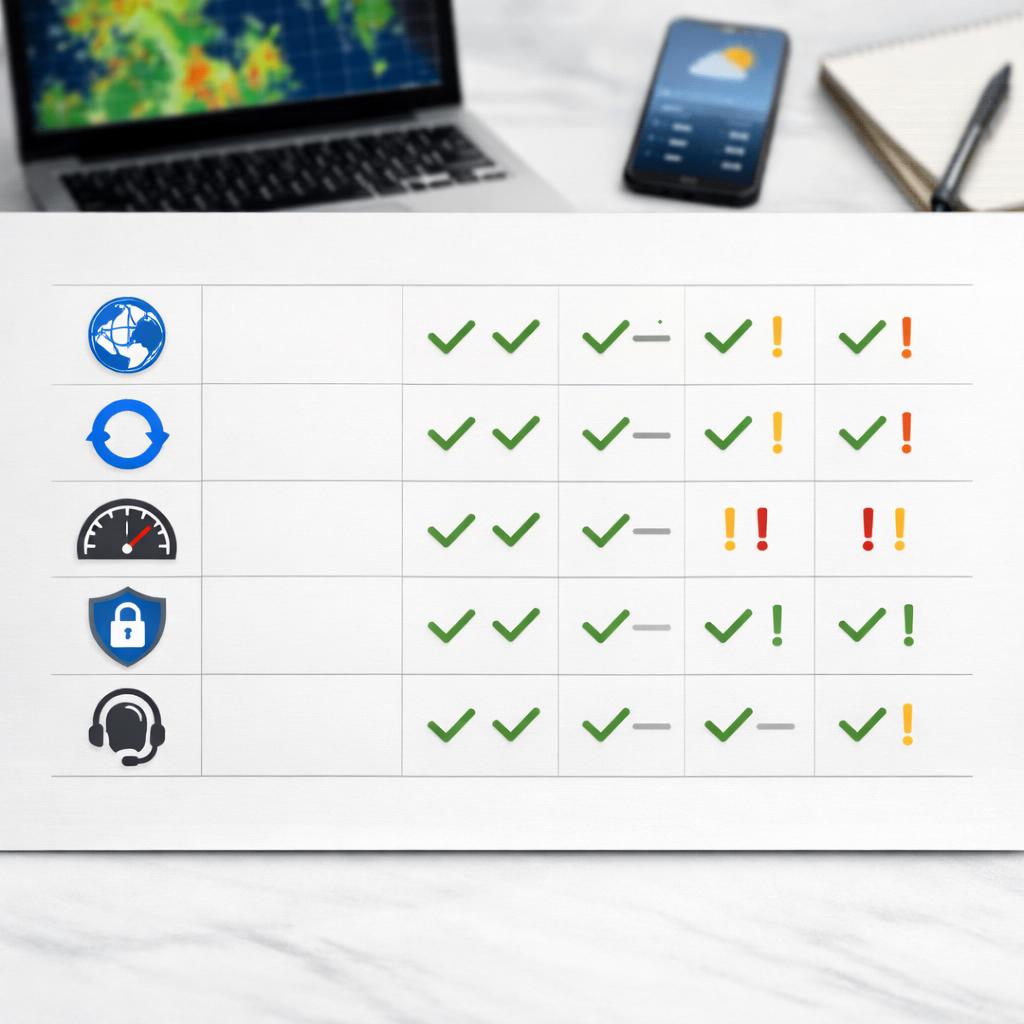
The best criteria start with coverage and data quality. Check whether the desired regions, cities or coordinates are well supported and whether the data suits your target group. Then pay attention to current events: how often is the forecast updated, how quickly does the link respond and is historical data or warnings available? Accuracy is more difficult to measure, but you can look at consistency by region, documentation of sources and the way uncertainty is represented.
In addition, application limits, price structure and support are often decisive. Costs and limits of a weather forecast link can vary greatly depending on the number of requests, type of data and retention period. Pay attention to peak loads, error messages when exceeding and options to spread traffic via temporary storage or smart refresh. Always keep a comparison practical: is the link connected to public information, internal management or both? It is precisely that context that determines whether a solution works well in practice.
Coverage, timeliness, accuracy and request limits
A useful minimum set usually consists of temperature, precipitation, wind, time period, location and a clear description of the forecast. For some applications, warnings, humidity, perceived temperature or visibility are also necessary. Always test multiple scenarios: busy hours, different regions and unexpected peaks. This way you can see more quickly whether a selected connection also remains intact outside standard conditions.
Conclusion
A strong choice for a weather forecast integration API does not start with a separate list of functions, but with the purpose of your application. If you have a clear picture of which processes or user questions are affected by weather, you can make more targeted assessments of coverage, timeliness, accuracy, limits, costs and management. This prevents you from opting for too much data, too little reliability or a pricing model that does not fit with growth.
For those who want to implement a weather forecast connection, the best approach is usually practical and step-by-step: determine usage, test per region, assess performance under load, and set up security and error handling right from the start. Also view the explanation about error handling and security if you want to properly organize reliability and management. In this way, the weather forecast integration API becomes not just a technical connection, but a valuable building block for better planning, smoother logistics and a more relevant customer experience.

Frequently asked questions
What minimum data should a weather forecast link provide?
At a minimum, temperature, precipitation, wind, time or period, location recognition and a clear description of the forecast are desirable. Warnings, humidity and perceived temperature can also be important for operational processes. Above all, choose data that is directly usable in your application, so that you do not add unnecessary burden or costs.
How do you assess the reliability of weather data for multiple regions?
Compare performance per region, test at different times and check whether the refresh is equivalent everywhere. Also look at consistency of the data, documentation of origin and the way in which deviations or uncertainty are explained. A short trial with real use cases often provides more insight than documentation alone.
When is temporary storage useful for weather data?
Temporary storage makes sense if many users request the same information or if you want to control costs and limits. It also helps reduce load times, as long as you use an appropriate refresh rate and avoid outdated data. Especially in busy applications, this can make the difference between stable performance and unnecessary peak loads.
How do you keep the costs of a weather forecast connection manageable?
Start by understanding the expected number of requests, peak times and types of data required. Limit unnecessary calls, use temporary storage where appropriate and continuously monitor consumption so that you can make timely adjustments in the event of growth or changing use. Also pay attention to price differences between basic data, alerts and historical information.