Short answer: the best plug-in home battery in 2026 depends on your nighttime consumption, your available group and the rules that apply to your home. For households that want to store more solar power and expand later, Anker SOLIX Solarbank Max AC is a serious option to compare early. With 7 kWh basic capacity and expandability up to 42 kWh, this system is especially suitable for homes with a clear solar surplus or a dynamic electricity contract.
So there is no one best plug-in home battery that is automatically the right choice for everyone. The outcome mainly depends on capacity, safe output power, placement, expandability and whether you want to use more than 800 W. That is precisely why it makes sense to compare the Anker SOLIX Solarbank Max AC product page with your own meter data: the system offers a lot of storage and flexibility, but higher powers do require additional control of the group, installation and registration.
When is a plug-in home battery the best choice?
A plug-in home battery makes particular sense if you generate more solar power during the day than you directly use and want to use that power later in the evening or at night. In the Netherlands, this is becoming increasingly important, because supply is becoming less financially self-evident and self-consumption is becoming more important. The best plug-in home battery is therefore usually not the model with just the highest storage, but the model that fits well with your real consumption profile.
Such a system is especially interesting if you want to start easily without immediately having a completely fixed battery system installed. This applies, for example, when your evening consumption is clearly higher than your daytime consumption, or when you want to take advantage of cheap electricity hours and use that electricity later. A large plug-in home battery is less suitable if you have little surplus, have low total consumption or if your electrical installation leaves little space. Then careful comparison becomes more important than simply choosing the largest battery.
Suitable for and less suitable for
This breakdown helps you more quickly assess whether a plug-in solution suits you:
- Suitable: households with solar panels, clear evening or night consumption, need for gradual expansion and sufficient space in a safe place.
- Also suitable: homes with a dynamic electricity contract where charging at cheap hours can be attractive.
- Less suitable: households with little generation, little night consumption or an installation that does not allow a higher load.
- Extra control required: situations in which you want to work above 800 W or a separate group and registration may be necessary.
What will you pay attention to in 2026 in terms of capacity, power and rules?
When choosing the best plug-in home battery, three points are guiding: how many kilowatt hours you really need, what output power is practical and permitted, and whether you want to expand later. Capaciteit moet aansluiten op je avond- en nachtverbruik, niet alleen op het piekvermogen van je zonnepanelen. For many households, 7 kWh can cover a large part of night-time consumption, but this remains dependent on meter data, family size and devices such as a heat pump, charging point or dryer.
The power requires extra attention. Regular plug-in use and higher powers are not the same. Above 800 W, additional conditions may apply, such as a separate group, installation inspection and registration according to local rules. A higher power is therefore especially interesting if you really benefit from it at home, for example to use stored solar power at peak times. Therefore, do not just look at what is technically possible, but especially at what is safe and appropriate for your home.
The financial side also requires sobriety. Savings remain an estimate, not a fixed outcome. Electricity price, generation, charging behavior and seasonal consumption vary greatly per household. Anyone who compares a battery is therefore wise to first view meter data over several weeks or months and only then choose a capacity.
Why Anker SOLIX Solarbank Max AC should be included early in the equation
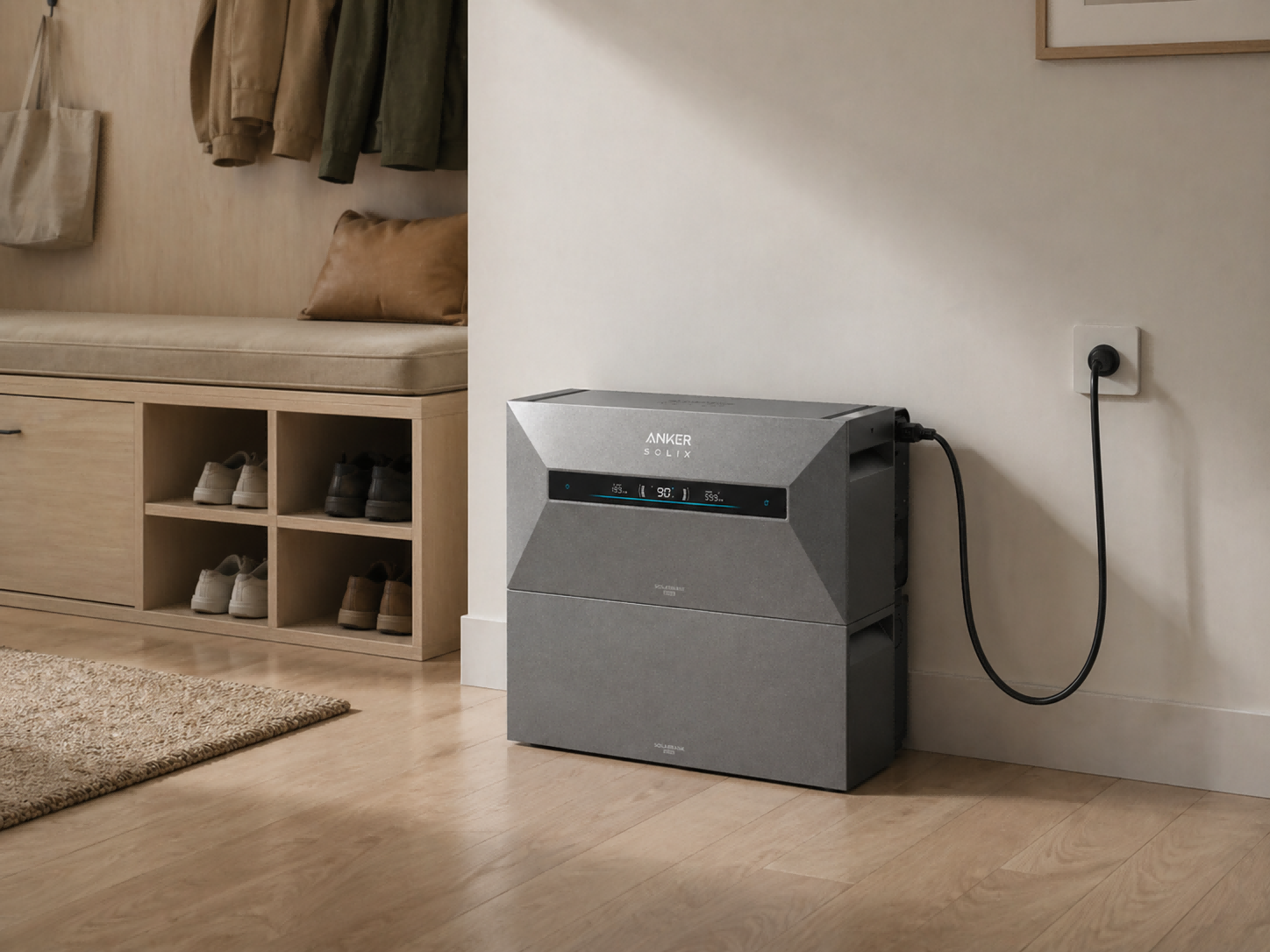
Anker SOLIX Solarbank Max AC deserves an early place in the comparison because this system is aimed at households that are not only looking for a plug-in home battery now, but also want to add more storage later. The basic capacity is 7 kWh and the system is expandable up to 42 kWh. This makes it especially relevant for homes where evening consumption is higher, where a larger solar surplus is available or where you want to grow gradually instead of investing as much as possible immediately.
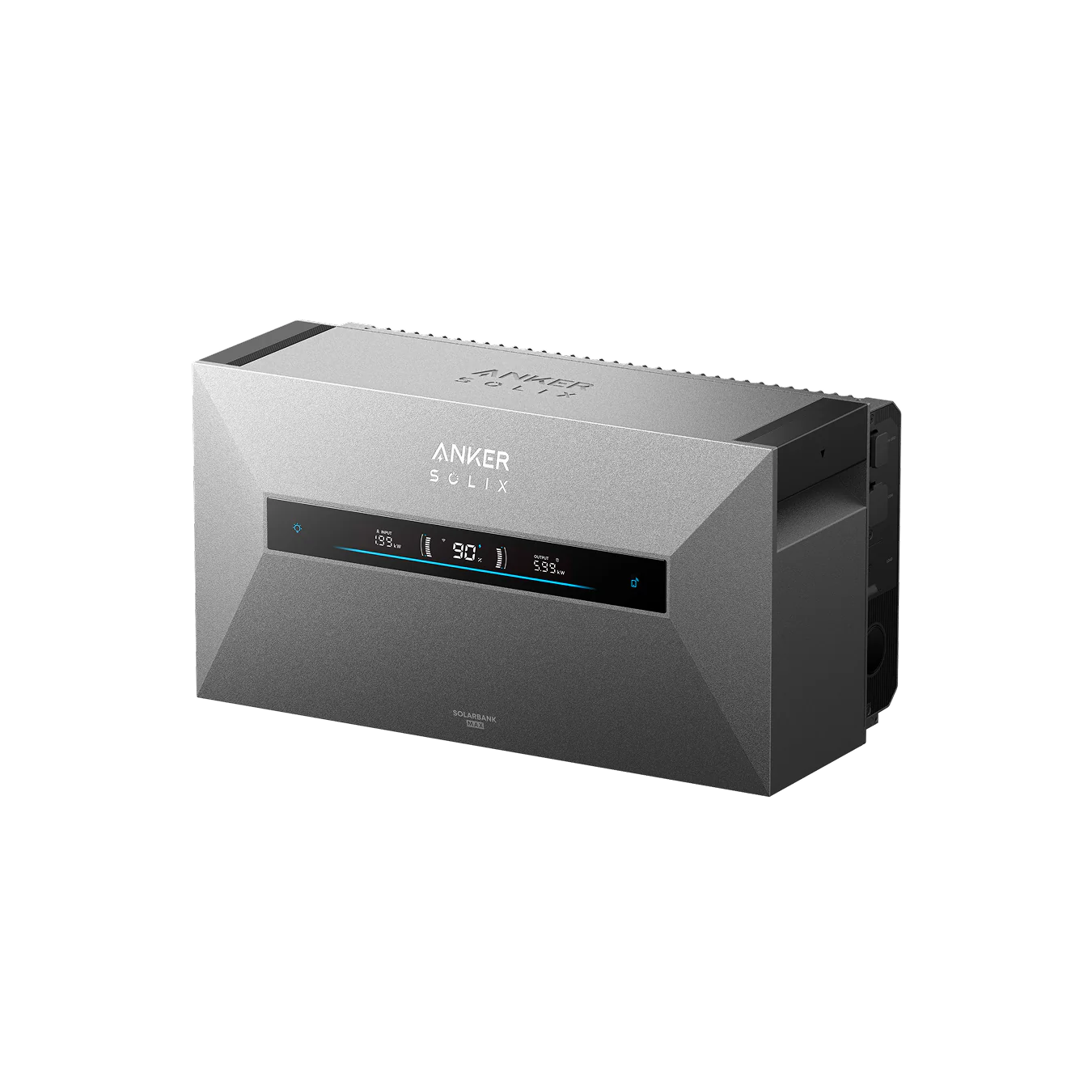
Anker SOLIX Solarbank Max AC
Product description
It is also a model that makes your scenario clear: if you mainly want a small buffer, then so much expandability may be unnecessary. If you want to save room for later, this is exactly why it is worth including it early in your comparison. This prevents you from first purchasing a solution that is too small and having to start over later.
In practical terms, the system stands out due to the combination of storage, placement options and higher powers. According to the product specifications, it supports 3500W grid-tied, 3680W off-grid and 5000W total power. The manufacturer also mentions LFP cells, 10,000 cycles, 10-year warranty, a design life of 15 years, complete discharge, protection for placement in various environments and active heating down to minus 20 degrees. Garage, basement and balcony are also mentioned as possible installation locations. This makes the system widely applicable, but it is precisely those higher powers that make prior checking important.
- Capacity: 7 kWh base, expandable to 42 kWh
- Power: 3500 W grid-connected, 3680 W off-grid, 5000 W total
- Location: including garage, basement or balcony, depending on the local situation and product conditions
- Important check point: at higher powers, group, connection method, installation check and registration are decisive
When this choice is logical and when additional check is necessary
Anker SOLIX Solarbank Max AC makes particular sense if you already have solar panels, want to cover a noticeable evening consumption and want to retain the option to scale up later. The model is less obvious if your consumption is low, you hardly have any surplus or if you are mainly looking for a small and simple buffer. Additional checks are necessary if you want to assess whether higher powers are safe and permitted in your home. Then not only the product specifications, but also your group, cabling, connection method and the reporting obligation count in your situation.
How do you assess payback time and suitability at home?
The best plug-in home battery is ultimately the solution that is technically suitable and feels financially defensible. Therefore, first look at your nighttime consumption, your surplus of solar panels and your available group. If you regularly use 6 to 8 kWh in the evening and night, a system with 7 kWh storage can be a logical starting point. If you also have plans to charge electrically, use more devices at the same time or store more solar power later, expandability becomes an important selection criterion.
The same nuance applies to the economic assessment. Calculation examples can provide guidance, but they are no guarantee for your house. The actual result depends on your generation, rate, charging times, seasonal pattern and the way you use the battery. Anyone who only looks at a nice payback period often misses the most important question: does this battery suit my use, or am I paying for capacity and power that I rarely use?
The wisest next step is therefore simple and concrete: compare your nightly consumption, the space in your group, your desired storage, the possibility of expansion and the official product specifications. This is especially useful if you are considering Anker SOLIX Solarbank Max AC, because this system is especially valuable for households that can actually utilize that larger capacity and future growth.
Sources and Control Points
Use the resources below to check regulations, registration and policy context for a plug-in home battery in the Netherlands. In addition, always check the product specifications and installation conditions on the product page before making a choice.
- class="ql-ui" contenteditable="false">Energieleveren.nl — Register installation — https://www.energieleveren.nl/
- Central government — Offsetting self-generated electricity — https://www.rijksoverheid.nl/onderwerpen/energie-thuis/question-en-response/hoe-werkt-de-salderingsregeling-voor-zonnepanelen
- Grid Management Netherlands — Information about the electricity grid and feed-in — https://www.netbeheernederland.nl/ the best plug-in home battery for an average household?
For an average household, the best plug-in home battery is usually the model that matches evening and night consumption, connects securely to the installation and leaves room for future changes. If you regularly have a surplus of solar panels and want more than just a small buffer, an expandable system often makes more sense than a minimal entry-level solution.
What should I pay attention to with a plug-in home battery with more than 800 W power?
Pay particular attention to the group, the cabling, the connection method and the registration. Above 800 W, additional conditions may apply, such as a separate group and additional control of the installation. Higher powers are especially useful if you really want to meet peak consumption at home or use stored solar power more quickly.
How much capacity do I need if I mainly want to accommodate night-time consumption?
That depends on your actual usage between sunset and the next morning. For many households, 7 kWh can cover a large part of that consumption, but it is not a fixed standard. Therefore, check your meter data over several weeks to avoid choosing a system that is structurally too small or unnecessarily large.
When is Anker SOLIX Solarbank Max AC a logical option and when should I check extra?
This model is especially logical if you already have solar panels, want to cover more evening consumption and want to retain the option to expand later. Additional control is necessary if your consumption is low, if your installation offers little space or if you want to use higher powers. Then check your nighttime consumption, available group, desired connection method and the conditions that apply to your home.
Conclusion
The best plug-in home battery in 2026 is not automatically the system with the highest storage or highest power, but the solution that suits your consumption, your home and the applicable installation conditions. For Dutch households with solar panels or a dynamic electricity contract, a plug-in home battery is especially interesting if you have surplus energy during the day and want to use it later. Capacity, expandability, placement and the practical limits around higher powers remain the most important selection criteria.
If you want to cover more nighttime consumption, install flexibly and scale up later, Anker SOLIX Solarbank Max AC is a logical candidate for early comparison. Now compare your nightly consumption, the space in your group, your desired storage, your expansion wish and the official product specifications on the product page. This way you can better assess whether this system suits your home technically, practically and financially.