Ballast is often necessary for solar panels on a flat roof, but not automatically in every situation. By ballast we mean extra weight that holds the mounting system in place if the panels are not or hardly anchored in the roof structure. The short answer is therefore: yes, often, but only if carrying capacity, wind load and system choice are well matched. Anyone looking at solar panels on a flat roof will therefore not receive a standard answer, but an assessment that differs per roof.
That is also the reason why solar panel ballast cannot be determined with a simple rule of thumb. The required amount depends, among other things, on the size of the roof, the height of the building, its location in relation to the wind, the angle of inclination of the panels and the chosen mounting system. Ballast can be practical because drilling in the roof covering is sometimes limited, but too much weight or incorrect distribution can cause new risks. Therefore, careful comparison is more useful than making a quick assumption.
What exactly ballast does for solar panels
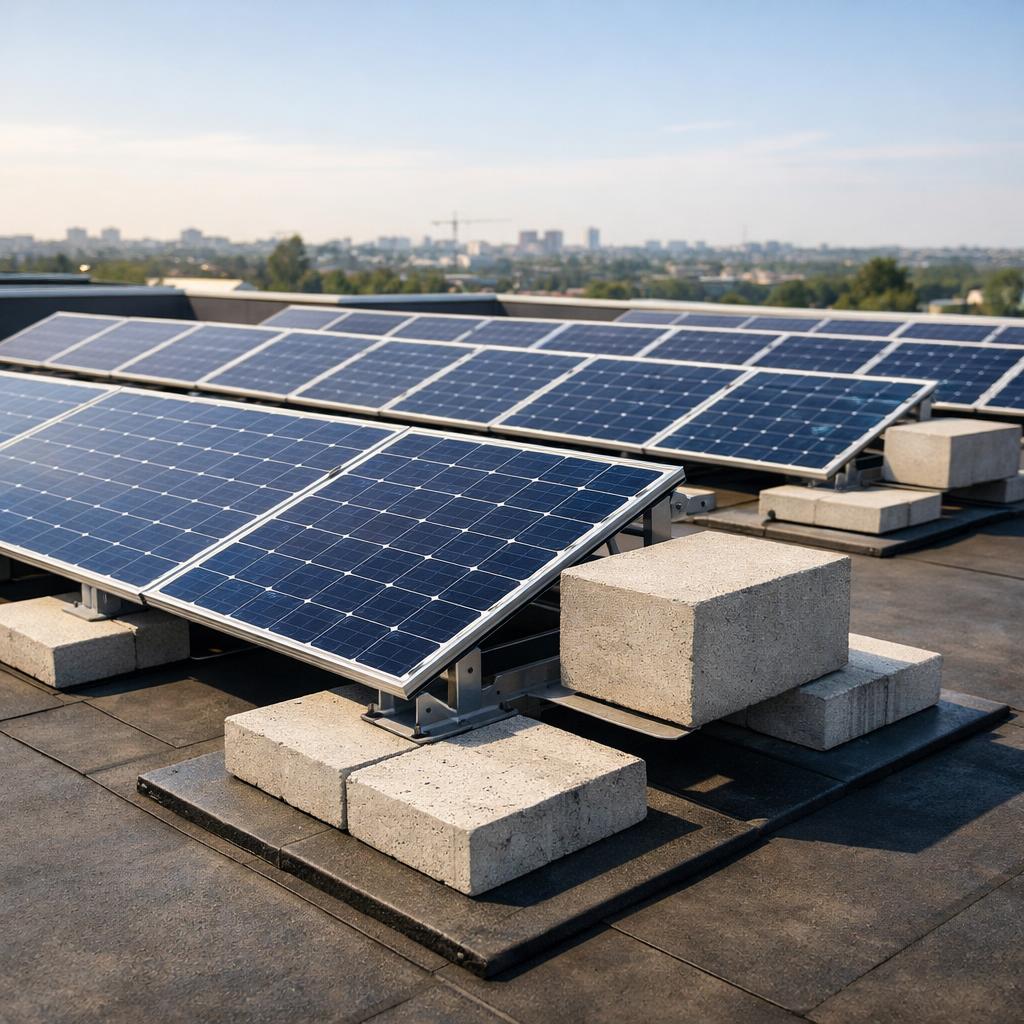
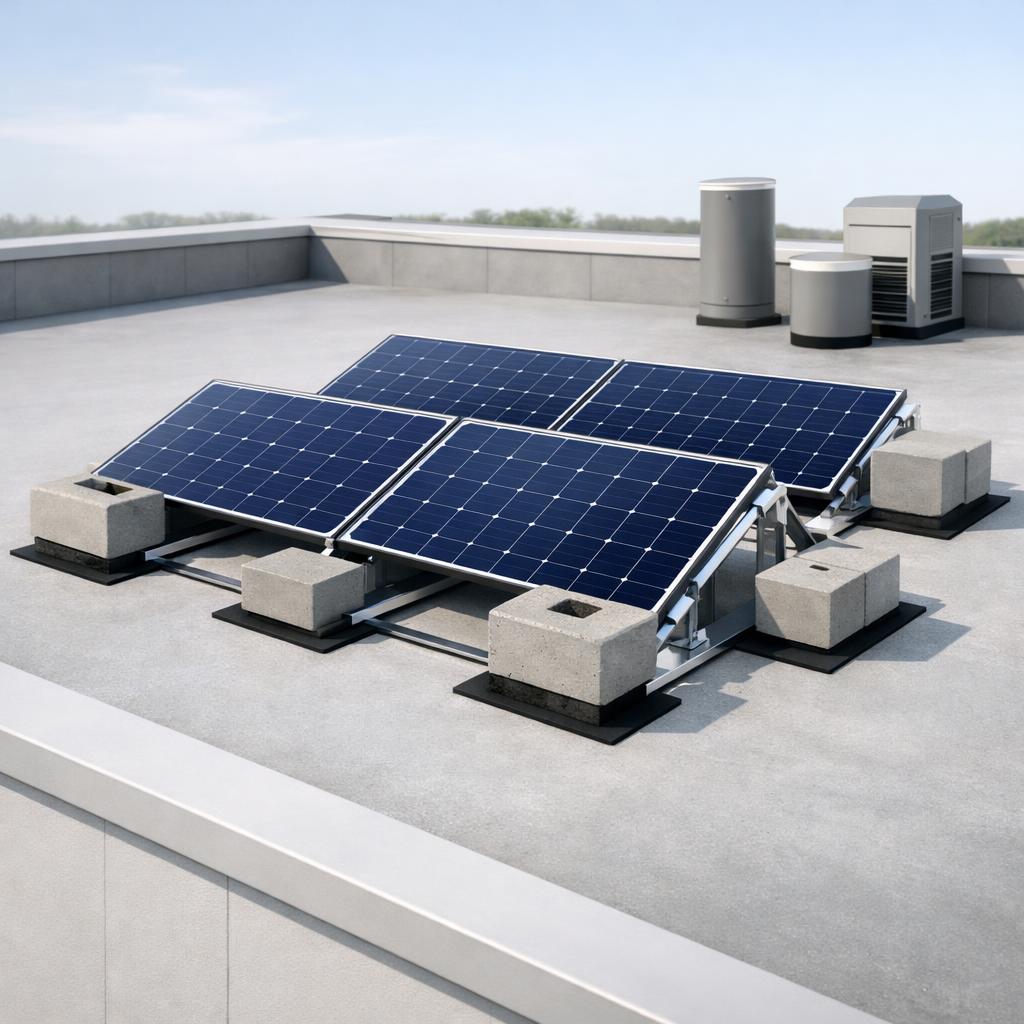
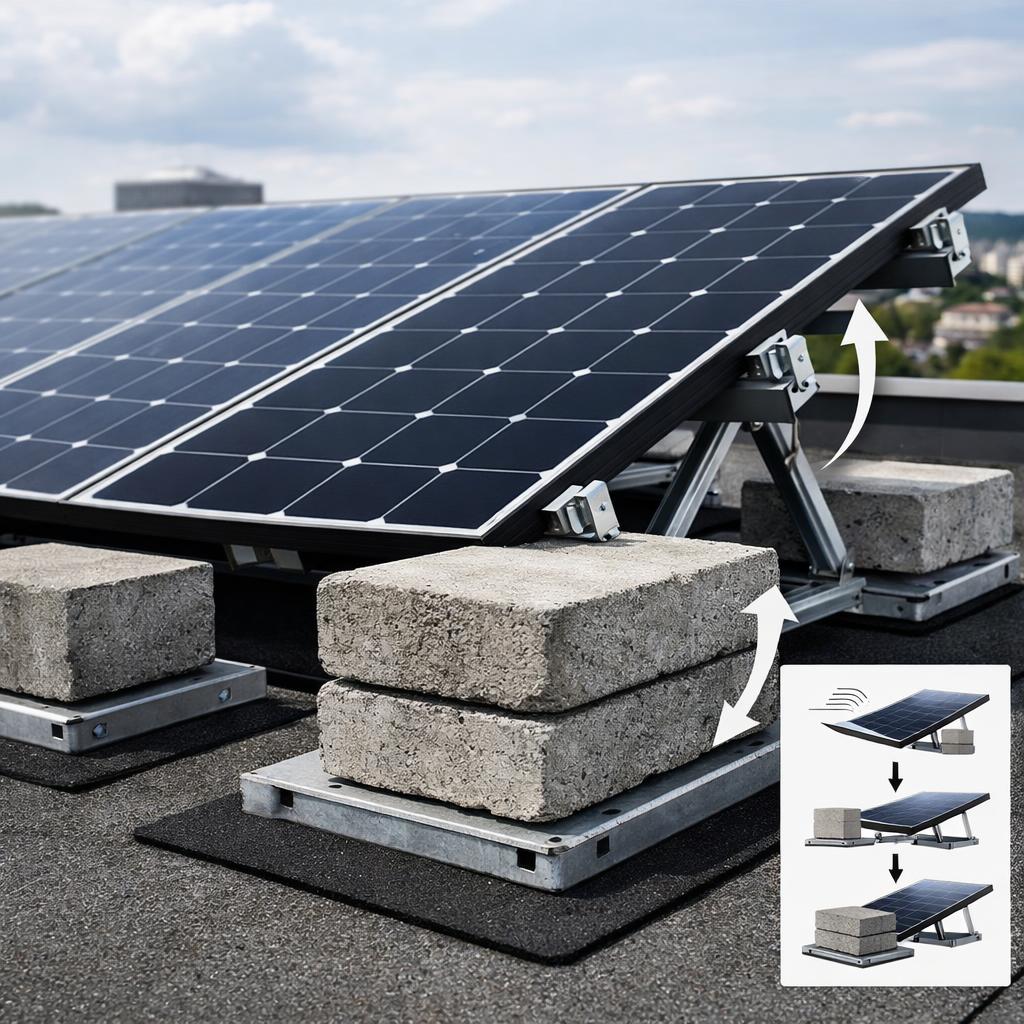
Ballast ensures that a mounting system offers resistance to blowing, shifting and tensile forces due to wind. This is especially important on a flat roof, because panels are usually placed at an angle and can therefore catch more wind. The extra weight is often distributed with concrete tiles, blocks or other aggravating parts that are part of the system. The function is therefore not only to add extra mass, but above all to ensure that the entire arrangement remains stable within the limits of the roof and the structure.
A ballasted arrangement is often suitable when anchoring through the roof is undesirable or remains limited. However, that does not mean it is always the best choice. The question of how much ballast is needed cannot be separated from the type of roof, the condition of the structure and the way in which wind moves over the building. What works well on a lower and sheltered building may be insufficient or too heavy on a higher or detached building.
In practice, ballast usually makes sense when a roof has sufficient load-bearing capacity, the roof covering remains suitable for the load and the mounting system supports a clear project-specific calculation. A different solution may be a better fit for light roofs, older buildings or locations with a lot of wind. Obstacles such as curbs, ventilation points or technical installations also play a role, because they influence the wind flow and weight distribution on the roof.
When a ballasted arrangement is usually suitable
A ballasted setup is often used in homes, outbuildings and business premises with a flat roof where one wants to disturb the roof covering as little as possible. Even if flexibility in placement is important, ballast can be attractive. Yet “suitable” remains something different from “always sensible”. A roof with limited reserve capacity or unfavorable wind load requires more restraint.
That is why it is smart to not only look at the solar panels, but at the entire system: roof structure, substrate, mounting system, weight distribution and the zones on the roof where wind has the strongest effect. The edges and corners in particular require extra attention. The required ballast may be different there than in the middle of the roof.
Which factors determine how much ballast is needed
The amount of ballast is determined by several factors at the same time. The bearing capacity of the roof, the height and shape of the building, its location in a more or less windy area, the edge zones of the roof and the angle of inclination of the system are important. The distance between the panels, the direction of installation and the shape of the mounting system also count. As a result, calculating ballast is in practice a technical assessment, not just a choice of a standard weight per panel.
That is precisely why it is wise to check the roof load and construction early in the process. Not only the total weight is relevant, but especially how that weight is distributed over the roof. A roof may have sufficient load-bearing capacity on paper, while local loads around support points or in certain roof layers are still a point of attention. Without that check, the question of how much ballast is needed for solar panels on a flat roof remains too general to answer reliably.
Assess roof load, wind zone and slope angle together
Roof load, wind zone and slope angle must always be viewed together. A low slope angle can cause the wind to flow across the system differently than a steeper setup. A building on the coast, on an open site or at a higher altitude will also have to deal with different circumstances than a sheltered residential building. This means that ballast does not have to be the same everywhere on the roof and is sometimes adjusted per zone.
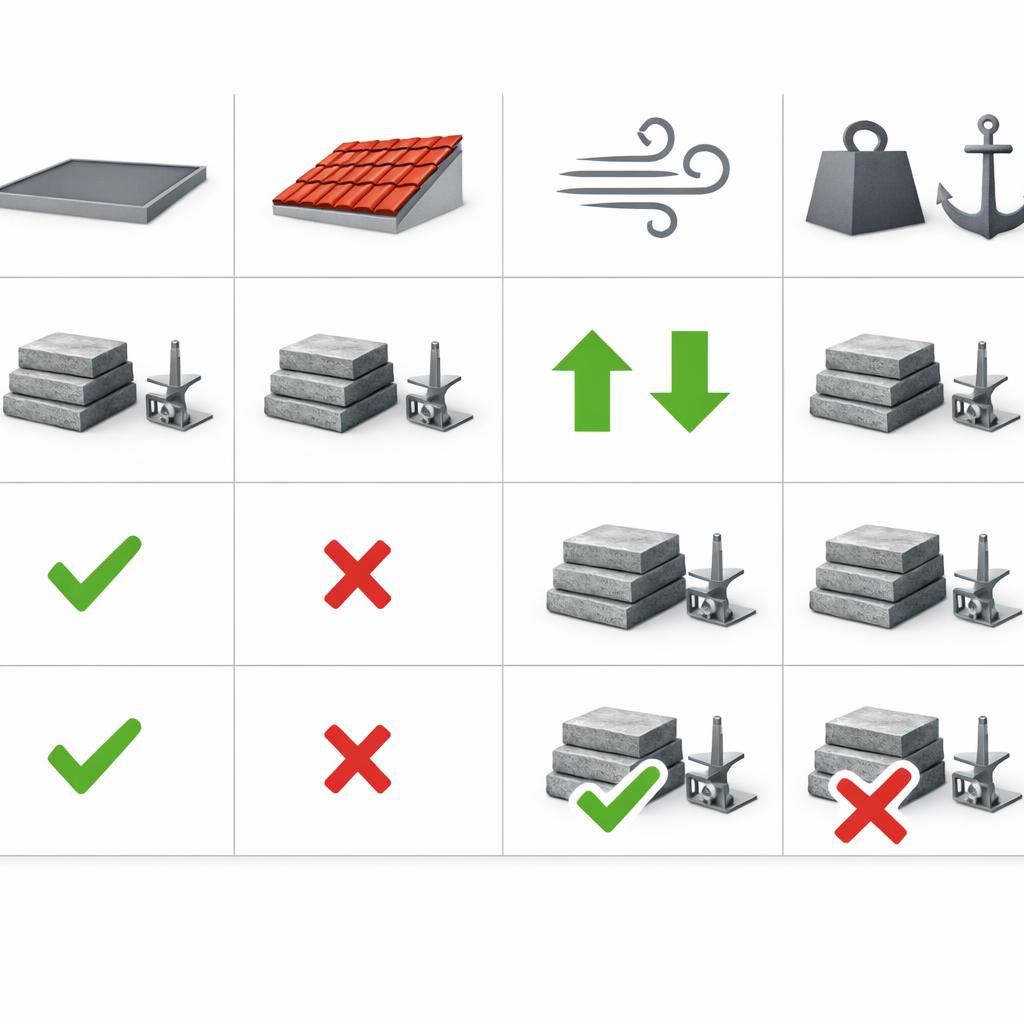
If you are in doubt between a ballasted setup and anchoring, it is wise to compare both options. Ballast can be beneficial if you want to break through the roof covering as little as possible. Anchoring may be a better fit when extra weight is a problem or when wind loads are unfavorable. So there is no fixed preference that applies to every roof. The best choice depends on the combination of load-bearing capacity, wind influence and system structure.
A useful way to compare is to look at these points:
Conclusion
Ballast solar panels is often a useful and logical solution on a flat roof, but not as a general standard for every building. The correct amount of ballast, and even whether ballast is desirable, depends on the roof construction, the load-bearing capacity, the wind load and the chosen mounting system. The most careful judgment is therefore: yes, ballast is often necessary or appropriate for solar panels on a flat roof, but only when the structural conditions have been properly checked.
Anyone who wants to compare systems is wise to first look at what is usually decisive: roof construction, wind load and system setup. Then follows the choice between ballast and anchoring. A mounting system is especially worth comparing if it fits your situation well, for example due to favorable weight distribution, limited roof penetration, simple installation or clearly checked specifications. Therefore, not only compare the panels, but also the mounting system for weight, distribution, maintenance space and suitability for your roof. Then check the official specifications and confirm whether the load-bearing capacity, wind conditions and installation method really match.
Frequently asked questions
What does ballast mean for solar panels?
Ballast is extra weight that helps hold a solar panel mounting system in place. This is especially used on a flat roof when panels are not or only to a limited extent attached to the roof construction. The aim is to make the setup more resistant to wind forces and shifting.
How is it determined how much ballast solar panels need?
This depends on several factors, such as the load-bearing capacity of the roof, the height of the building, its location, the wind load, the angle of inclination and the shape of the mounting system. The outcome therefore always depends on the project. A general guideline can help with initial orientation, but does not replace a targeted assessment.
Is ballast always better than anchoring on a flat roof?
No, that varies per situation. Ballast can be attractive if you want to disturb the roof covering as little as possible. Anchoring can be better when extra weight is undesirable or when the wind load is more important. The best choice only arises after comparing load, placement and structural options.
Can I decide for myself whether my roof has enough load-bearing capacity for ballast?
Only in broad terms. You can look at the roof type, age of the building and available construction data, but this does not yet guarantee suitability. Because weight distribution, roof structure and local loads also play a role, it is wiser to have the construction checked before you finally opt for ballast.