Short answer: yes, a home battery can qualify for financial benefits in the United States, but only if your situation fits within the rules of the scheme. In practice, this often concerns a federal tax credit, supplemented with possible support from a state, municipality, grid operator or energy company.
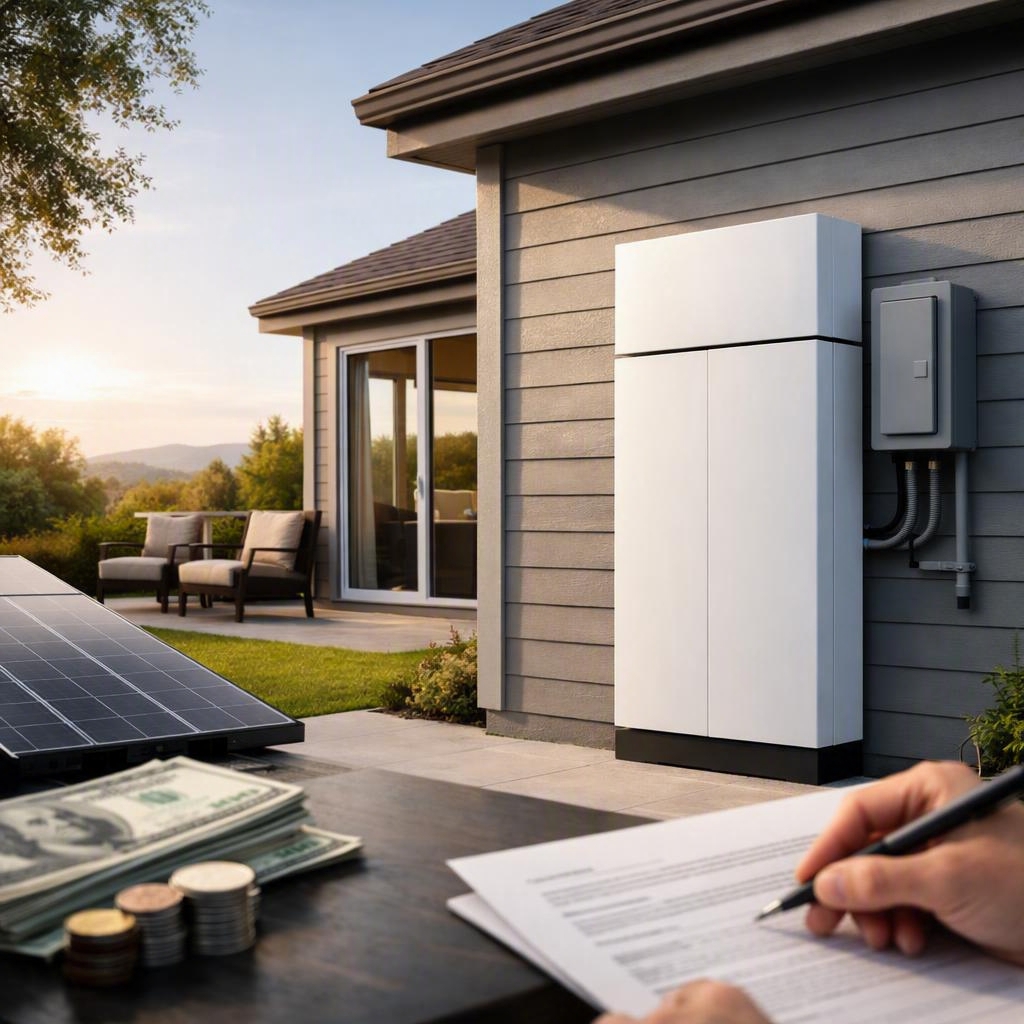
The most important step is to check in advance whether your battery counts as an independent system, what minimum storage capacity applies, what installation conditions apply and whether controls may be combined. Anyone who wants to include a home battery subsidy in the budget should therefore not rely on general information alone, but on the official conditions that apply to their own home. Also read about federal tax credits for home energy as a first check point.
What financial support for a home battery is available?
When it comes to home battery subsidies in the United States, it is wise to clearly separate three types of benefits. First, there is often a qualified home energy tax credit at the federal level. Secondly, states can offer their own schemes, such as a refund, a tax break or a temporary incentive program for energy storage. Thirdly, there are local programs from energy companies or grid operators, for example for emergency power, peak reduction or participation in a local storage program.
Difference between tax credit, government scheme and support from energy companies
These forms of support are similar, but have different effects. A federal tax credit usually reduces the tax you owe so it is not the same as a direct payout. A state scheme can be a fixed allowance or additional tax benefit. An energy company arrangement often depends on practical conditions, such as a recognized installer, a specific battery type, a fixed service area or participation in a specific program.
That difference is important, because the home battery subsidy is therefore not a fixed amount that is the same everywhere. In one state the financial support may be clear, while in another state mainly the federal part remains relevant. Also pay attention to the technical design: some schemes accept an independent battery system, while others mainly connect to a home with solar panels. It is therefore wise to also look at home batteries with or without solar panels when assessing the suitability of your situation.
When is a home battery a logical choice or not?
A home battery mainly makes sense if you have a clear goal. Consider emergency power in the event of a power outage, better use of self-generated solar power, lower exposure to time-dependent rates or participation in an energy company program in which stored power is used at certain times. In such cases it is easier to assess whether the investment is appropriate for the use and whether home battery subsidies really play a useful role.
Recommended situations and less suitable situations
A home battery is usually suitable for households that regularly suffer from outages, who generate a lot of their own solar power during the day but mainly use it in the evening, or who live in an area where rates vary greatly depending on the time of day. Storage can also be a logical choice when participating in a local program of an energy company, because the battery then serves not only for backup, but also for active energy management within the local scheme.
A home battery is often less suitable when the purpose of use remains unclear, when there is no usable local regulation, or when the installation costs are disproportionate to the practical benefit. There are also doubts. This is the case, for example, if you mainly want to use a control, but do not yet know whether the battery is technically suitable for your meter cupboard, inverter or desired backup function. Then the subsidy is not the starting point, but at most an extra advantage to a system that must first fit technically and financially.
The gist is therefore simple: home battery subsidies sometimes make a system more attractive, but do not automatically make an unsuitable system suitable. First look at your power consumption, your purpose, your local rate structure and the reliability of the grid in your area of residence. Only then can you meaningfully assess whether the scheme actually adds value.
Which conditions should you check in advance?
Not every home battery or installation automatically qualifies for financial benefits. Therefore, always check whether it concerns residential use, whether the installation date falls within the applicable period, what minimum storage capacity is required and whether the technical configuration complies with the regulations. Evidence of qualified costs is also important, as is whether the battery counts independently or only in combination with other home energy systems.
Capacity, connection, installation requirements and stackability of controls
In addition, pay close attention to the implementation rules. Some programs require a certified installer or prior approval. Other schemes are only available in a certain postcode area or to customers of a specific energy company. The combination of benefits also requires attention. A federal scheme can sometimes coincide with support from a state, municipality or energy company, but not if conditions are mutually exclusive or if another compensation affects the cost base on which the tax benefit is calculated.
A practical check works best if you compare four points:
- suitability of the home and the intended use;
- technical requirements such as capacity, connection and installation design;
- administrative requirements such as invoices, product specifications and approvals;
- possibilities and limitations when combining schemes.
Compare not only amounts, but also limitations and alternatives. Sometimes a smaller storage system makes more sense than a large installation. In other cases, simply installing solar panels or participating in a local program without a full emergency power function is a more suitable alternative. The proof of suitability is ultimately limited by the official program texts. General information helps with preparation, but is not sufficient as a basis for an application or tax assessment.
Sources and checkpoints
Always use primary sources for home battery subsidies and check whether a scheme is still open. Conditions, amounts and technical requirements may change. In any case, check your state, your energy company, the product specifications of the battery, the installation date, the cost items that count and whether multiple schemes can be combined. Only then compare quotes, capacity and expected yield.
- United States Internal Revenue Service, Residential Clean Energy Credit, https://www.irs.gov/credits-deductions/residential-clean-energy-credit
- United States Department of Energy, Homeowner's Guide to the Federal Solar Energy Tax Credit, https://www.energy.gov/eere/solar/homeowners-guide-federal-tax-credit-solar-photovoltaics
- Database of State Renewable Energy and Energy Efficiency Regulations, Overview of Energy Storage Regulations, https://www.dsireusa.org/
- United States Department of Energy, Battery Storage for Residential Energy Systems, https://www.energy.gov/energysaver/battery-storage-residential-energy-systems
Frequently asked questions
Is there a home battery subsidy or just tax credit in the United States?
Both occur. At the federal level, this often concerns tax benefits, while states, municipalities and energy companies sometimes offer separate subsidies or concessions. Which form applies to you depends on your location, system type and program conditions.
Can I also have a home battery without solar panels count towards a scheme?
This is possible in some cases, but not automatically. You should check whether the control accepts a standalone battery, what minimum capacity applies and whether the system has been installed correctly and for residential use. The precise requirements differ per scheme.
Can I combine federal support with a scheme from my state or energy company?
Sometimes yes, but only if the conditions are not mutually exclusive. Pay particular attention to the order of applications, which costs you are allowed to claim and whether another allowance affects the amount on which the tax benefit is calculated.
When is a home battery a logical option and when should I check extra?
A home battery is a logical option if you have a clear goal, such as emergency power, better use of solar power or benefits from time-dependent rates. Additional checks are necessary if your technical situation is unclear, if you want to combine schemes or if you still have to determine whether capacity, installation conditions and official specifications really suit your home.
Conclusion
Home battery subsidies are certainly possible in the United States, but only under clear conditions. The short verdict remains: yes, but only if your location, system setup, storage capacity and the official rules of the program match. A federal tax credit, a state scheme and support from an energy company can be valuable together, but that does not automatically apply to every battery or every home.
The sensible next step is to compare your own consumption, available control, installation conditions, actual storage capacity and official product specifications. Then check whether controls may be combined, which costs count and whether your installer meets the requirements. This way you can assess more specifically whether the home battery subsidy is really applicable in your situation and which installation is best suited.