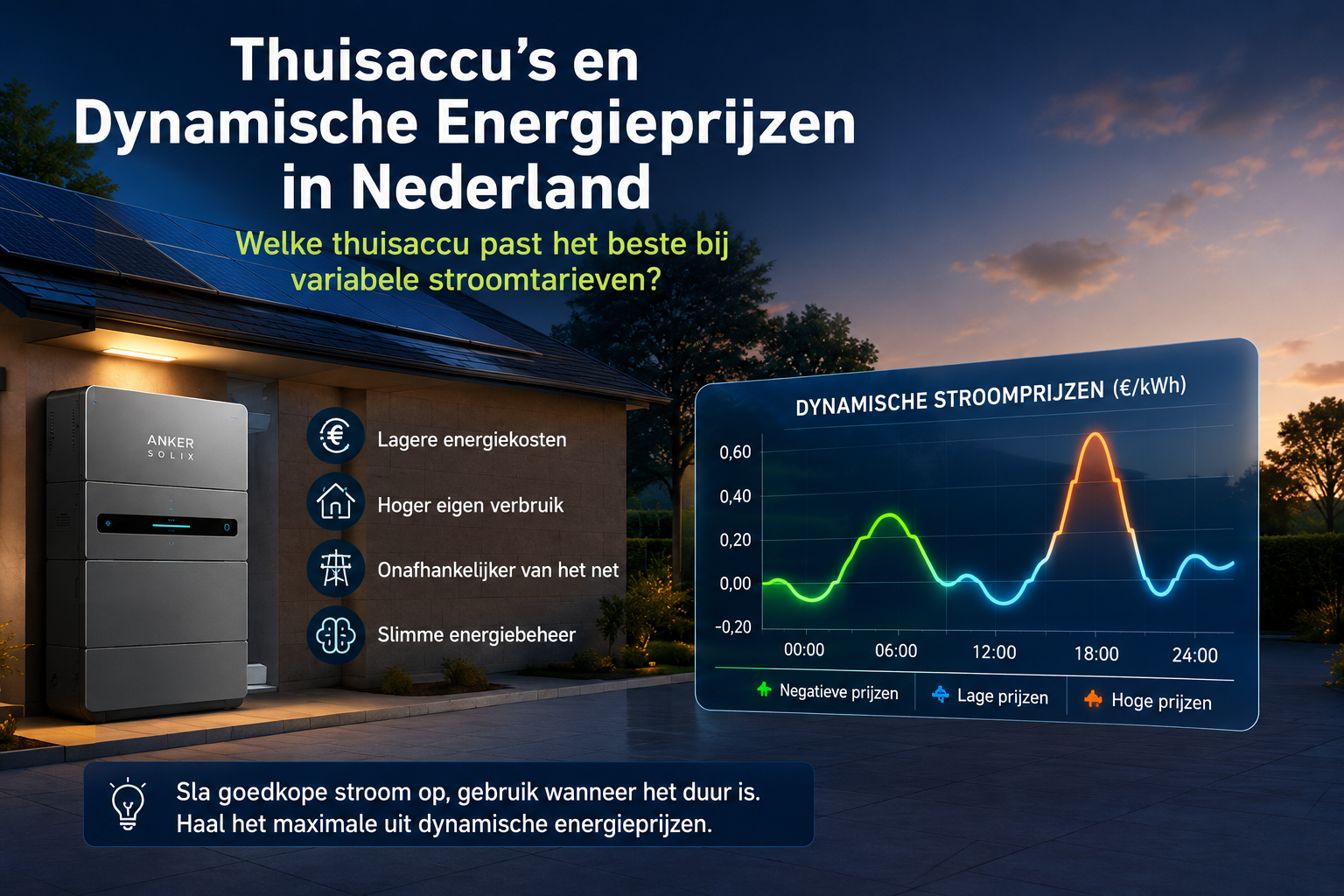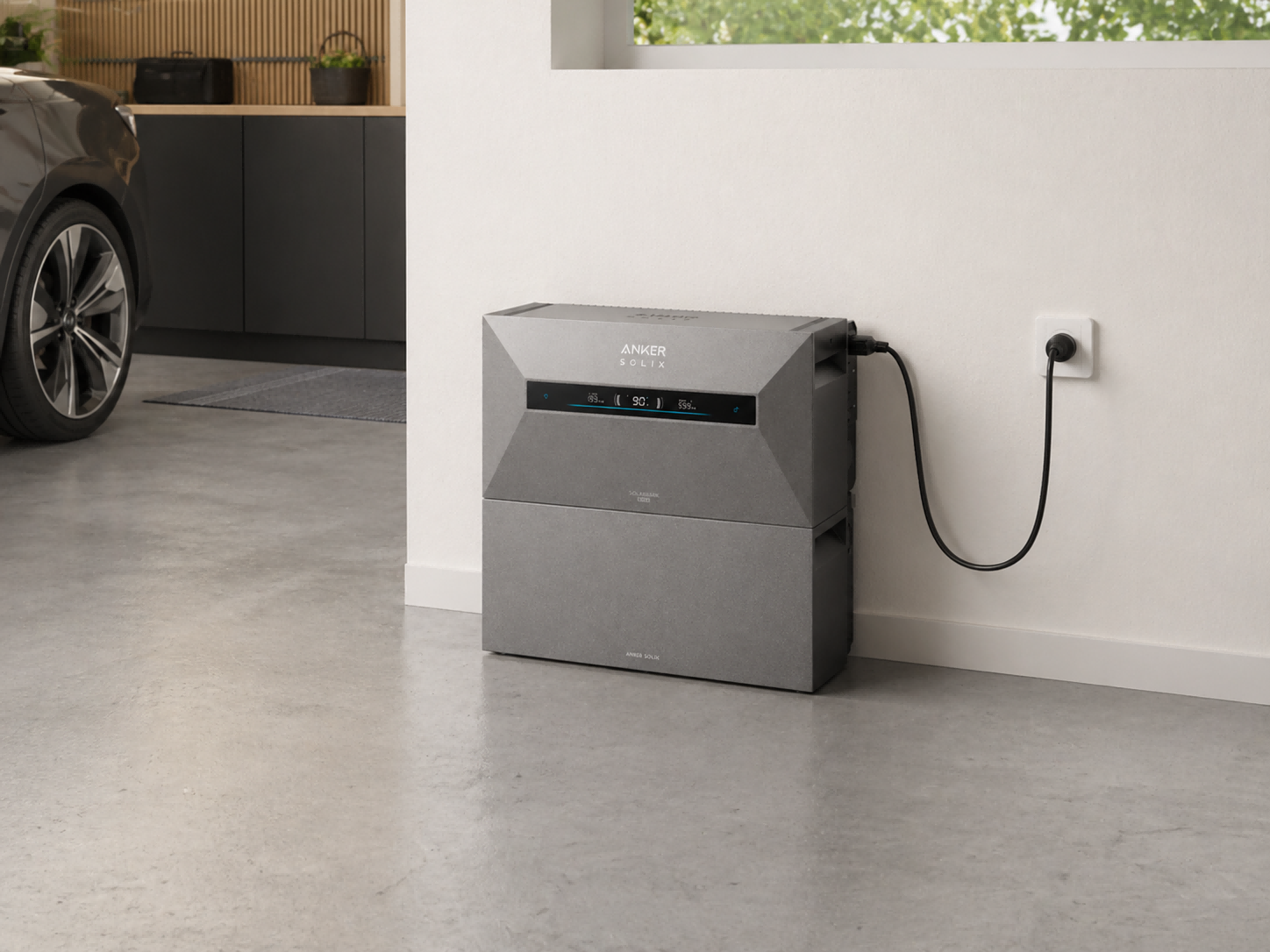
Which home battery provides the most savings per month with a dynamic contract?
Short answer: With a dynamic contract, the largest home battery usually does not automatically yield the highest monthly savings, but the battery that fits well with your consumption, solar panels, charging times and installation situation. For many households, comparing the Anker SOLIX Solarbank Max AC early makes sense, because this system starts with 7 kWh, can be expanded later and can adjust the charging and discharging per day to electricity price, consumption and weather forecast.
The greatest savings occur mainly when cheap hours, own solar power and later consumption during expensive hours are well matched. As a result, it is not only capacity that counts, but also power, automatic control, expandability and whether your home is technically suitable. Anyone who looks purely at storage size often misses the most important part of the calculation.
What does the monthly savings with a dynamic contract really depend on?
The basis is simple: you save the most when you store electricity during cheap hours or when there is a solar surplus and use that electricity later when the hourly price is higher. In practice, the outcome is less simple. A larger battery can store more power, but if your daily surplus is limited or your evening consumption remains low, part of that capacity is not or rarely used. Then the investment grows faster than the actual savings.
For most households, four points are decisive: the daily surplus of solar panels, consumption in the evening and night, the difference between cheap and expensive hourly prices and the charging and discharging capacity of the battery. Households with a heat pump, electric car or relatively high night-time consumption often benefit from extra capacity and higher power. Households with a more modest consumption profile often get more out of a well-fitting battery than from a maximum system.
Error 500 (Server Error)!!1500.That’s an error.There was an error. Please try again later.That’s all we know.A home battery is especially profitable when it is regularly used for the most part. For example, if you need 5 to 8 kWh in the evening on many days, a system in that range often makes more sense than a much larger storage that is rarely fully used. The same applies to the electricity price: with large differences between cheap and expensive hours, smart shifting becomes more valuable, while that advantage decreases if the hourly prices are close to each other.
The question is therefore not only which home battery can theoretically yield the most savings, but above all which battery can charge and discharge most often at the right time in your situation. As a result, appropriate capacity, usable power and good daily planning are usually more important than just the largest storage in kilowatt hours.
When is Anker SOLIX Solarbank Max AC a logical choice?
The Anker SOLIX Solarbank Max AC is especially interesting for households that want to combine two things: using more of their own solar power and shifting smartly within a dynamic contract. The basic capacity of 7 kWh matches the night-time consumption of many Dutch households and offers a reasonable starting point for those who do not want to invest maximally right away. Doordat uitbreiding tot 42 kWh mogelijk is, blijft er ruimte om later op te schalen als het verbruik stijgt, bijvoorbeeld door een warmtepomp of elektrische auto.
It is precisely that combination of entry and later expansion that makes this model worth comparing early. For a household with uncertain future consumption, this may be more practical than immediately opting for a much larger system. You then first check whether the capacity, placement and actual benefits suit your home, without ruling out the choice for further expansion.
Productoverzicht in het kort
- Capaciteit: 7 kWh als basis, uitbreidbaar tot 42 kWh
- Power:3500 W grid connected, 3680 W off-grid and 5000 W total
- Control: automatic daily planning based on consumption, weather forecast and dynamic hourly prices
- Durability: LFP cells, 10,000 cycles, 10 year warranty and a 15 year design life
- Placement: stackable, without cables between the modules and suitable for multiple placement options
Suitable for and less suitable for
This system is especially suitable for households with solar panels, significant evening consumption, a need for emergency power or the desire to scale up later. Even if you first want to start with 7 kWh and only decide on expansion after a period of measuring, this is a logical option to include in your comparison.
The system is less suitable if your home does not have suitable installation options, if your daily surplus and evening consumption are very low or if you can hardly make use of the price differences within your dynamic contract. In zulke gevallen kan extra capaciteit op papier aantrekkelijk lijken, maar in de praktijk minder opleveren dan verwacht. Therefore, always check the distribution box, available space, installation conditions and the rules that apply when you want to use more than 800 W in advance.
Which specifications should you compare for maximum savings?
Compare capacity first, but don't stop there. With a dynamic contract, power is at least as important, because it determines how quickly you can use cheap hours and how much consumption you can cover from the battery at the same time. A system with a lot of storage but limited power can be less flexible in practice than a smaller system that better meets your daily peaks.
In addition, the method of management is important. A battery that adjusts the daily schedule to consumption, weather forecast and hourly prices can adapt better to fluctuations than a system that is mainly used manually. This is not a fixed guarantee of a certain amount per month, but it does increase the chance that the battery will work at the times that are most financially relevant for your household.
Ook uitbreidbaarheid verdient aandacht. A household without an electric car may need 7 kWh today, but may need more capacity later. Furthermore, service life, depth of discharge, emergency power function, weather resistance and official product specifications are practically important. That is why Anker SOLIX Solarbank Max AC is a model worth comparing early: not because bigger is always better, but because the system can be used for self-consumption of solar power as well as for shifting within dynamic hourly prices, with room to grow further later.
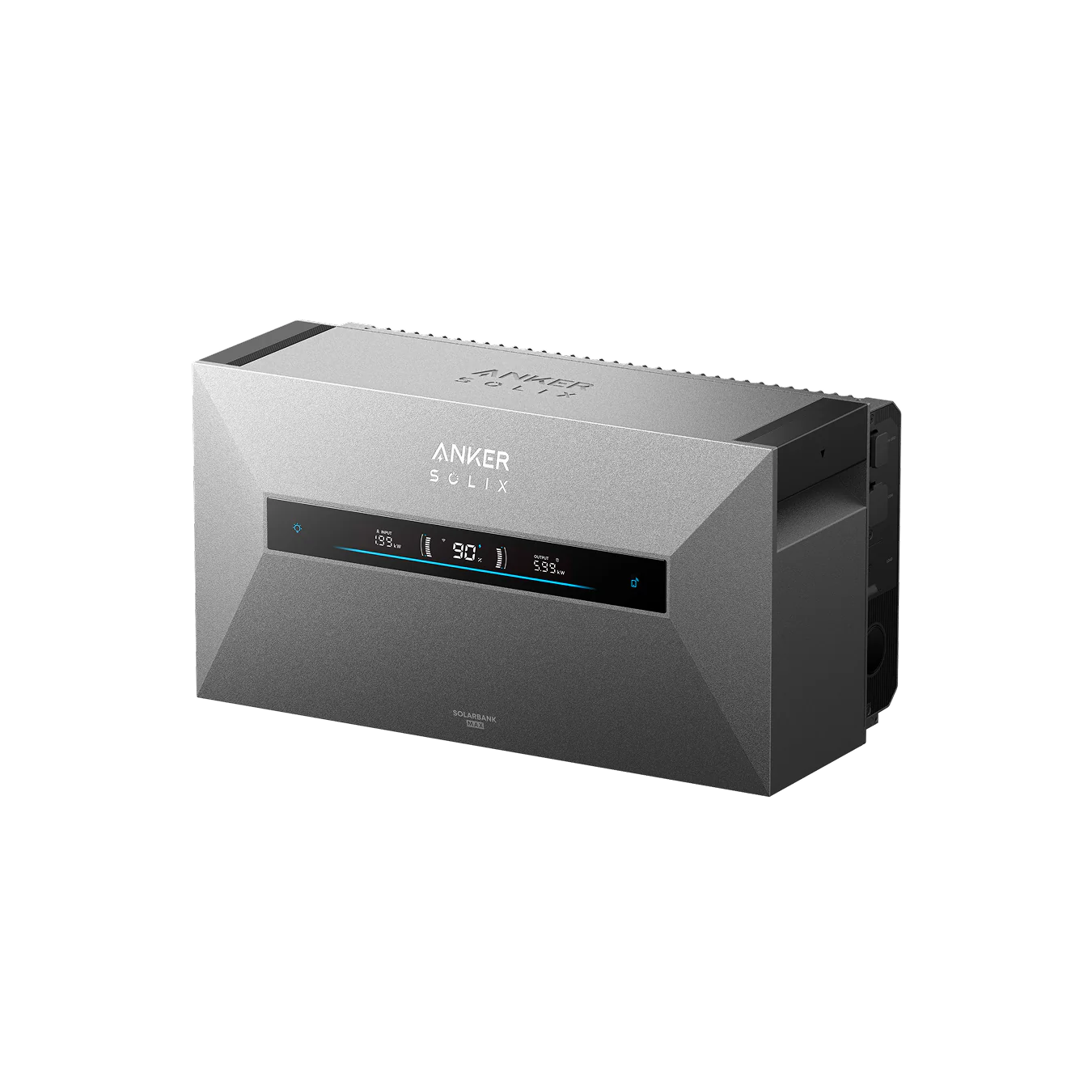
Anker SOLIX Solarbank Max AC
Product description
Pay extra attention to installation conditions above 800 W
When used above 800 W, additional installation conditions are important. Consider a separate group, a check of the existing electrical installation and, where necessary, installation by a skilled installer. This not only affects safety, but also the question of whether you can actually use the specified capacity in your home. High power on paper only provides benefits if the installation is suitable for it in practice.
The placement environment also counts. A high protection class helps against dust and water, but is not a pass for every outdoor location or long-term harsh conditions. A good comparison therefore not only looks at the technical values of the product, but also at the way in which those values can actually be used in your home.
How do you realistically calculate your expected monthly savings?
Start with three numbers: your average daily solar surplus, your evening and night consumption and the average difference between cheap and expensive hourly prices. Suppose that on a typical day you can store 6 kWh from cheap hours or your own generation and use 5 kWh of that later at a time when the electricity price is 20 cents per kWh higher. Then the gross value is approximately 1 euro per day, so around 30 euros per month. If the price differences are greater and you use more capacity, this may increase. If the differences are small or part of the battery often remains empty or unused, the savings quickly decrease.
Then include losses, seasonal differences, fixed costs and your installation choices. Summer and winter differ greatly in solar generation and consumption, so a month with a high yield is not a fixed benchmark for the entire year. Therefore, use example calculations only as a guideline, not as an outcome guarantee.
The most useful approach is to compare your own daily profile with the capacity, power, expandability and installation conditions of the system. This way you can see more quickly whether your benefit mainly comes from storing solar power, from charging during cheap hours or from a combination of both. This makes the choice of a suitable system more reliable than relying only on the largest stated savings.
Sources and checkpoints
- Authority for Consumers and Markets – Information about energy contracts and consumer rights – https://www.acm.nl/
- Rijksoverheid – Energy at home, solar panels and netting – https://www.rijksoverheid.nl/onderwerpen/energie-thuis
- Milieu Centraal – Home battery – https://www.milieucentraal.nl/energie-besparen/zonnepanelen/thuis Battery/
- Netbeheer Nederland – Information about the electricity grid and connections – https://www.netbeheernederland.nl/
- Anker SOLIX – Anker SOLIX Solarbank Max AC – https://www.ankersolix.com/nl/products/a17e2
When making your decision, always check these points: your actual daytime and evening consumption, the price differences within your dynamic contract, the technical suitability of your distribution box and connection, the installation space and the official product specifications. Savings examples remain indicative and may differ due to consumption, weather, grid costs and local rules.

Frequently asked questions
Which home battery best suits a dynamic contract?
The best choice is usually the home battery that suits your daily surplus, evening consumption and desired charging and discharging speed. A larger battery can provide more absolute savings, but only if you often use that capacity. For many households, an expandable system is therefore more logical than immediately choosing the maximum.
How much can a home battery save per month with a dynamic contract?
This varies greatly per household. The monthly savings depends on the number of kilowatt hours you can shift, the difference between cheap and expensive hours, the presence of solar panels and the efficiency of the system. Therefore, see examples as an indication, not as a fixed yield.
Is a larger battery always better for maximum savings?
No. A larger battery especially helps when you have sufficient surplus or cheap charging hours and later also enough consumption in more expensive hours. If this is lacking, part of the storage will remain unused and a smaller, better-suited system may make more financial sense.
When is Anker SOLIX Solarbank Max AC a logical option and what should I check extra?
This system makes sense if you have solar panels, want to shift evening consumption, consider emergency power important or want to expand from 7 kWh to more capacity later. Additional checks are required regarding the available space, the distribution box, the technical suitability of your home and the conditions for use above 800 W. It is precisely these points that determine whether the specified performance is also achievable in your situation.
Conclusion
The home battery that yields the most savings per month with a dynamic contract is usually not simply the largest battery, but the battery that best suits your daily surplus, evening consumption, power and installation situation. Capacity, usable power and good daily planning together determine whether you can really convert cheap hours and solar power into lower monthly costs.
For households looking for a flexible and expandable system, Anker SOLIX Solarbank Max AC is a logical option to compare early. Check your daily surplus, evening consumption, desired emergency power, available space, distribution box and the official specifications of Anker SOLIX Solarbank Max AC. This way you can see more quickly whether 7 kWh is suitable now, whether later expansion is more sensible and whether the installation conditions are well suited to your home.